
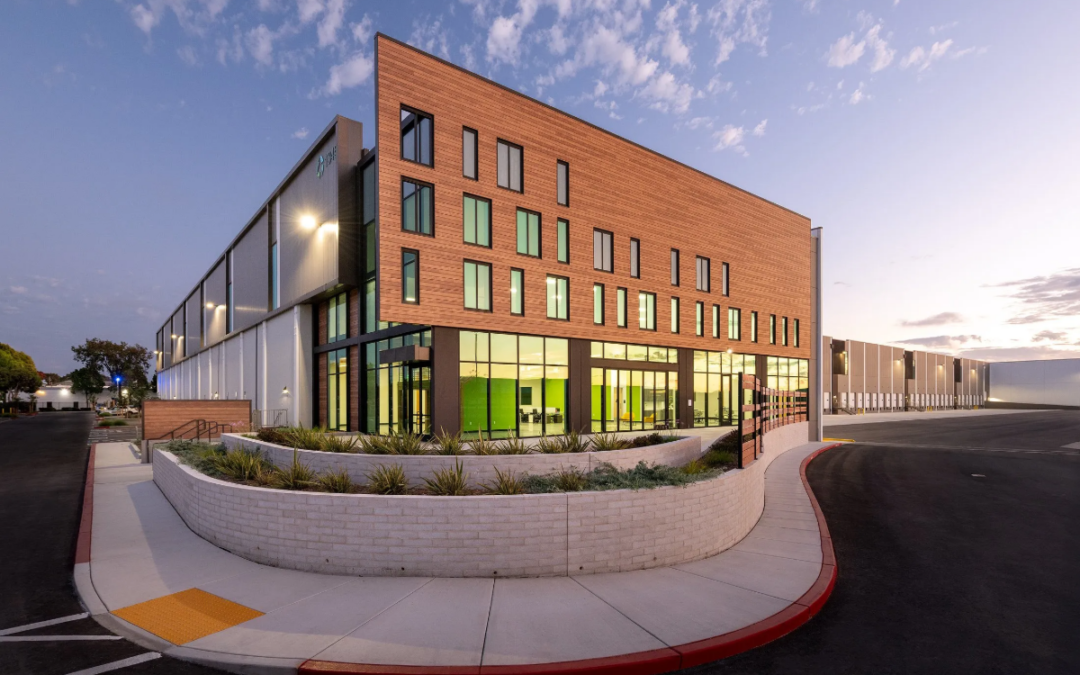
Image: Prologis Nexus, City of San Leandro, courtesy of Lowney Architect
The East Bay Economic Development Alliance (East Bay EDA) is excited to unveil the Next Generation Industrial Design Guidelines, a set of high-quality building and site design standards to help local jurisdictions attract investment, create jobs, and support a resilient regional economy. The guidelines were also informed by recent industrial projects and market trends in the Bay Area.
Funded by MTC’s Priority Production Area (PPA) Technical Assistance and Planning Grant Program, the guidelines provide a practical framework for communities seeking to modernize industrial areas while balancing economic development goals with community livability. The project was led by urban planning and design firms PlaceWorks and HPA Architecture.
The guidelines recognize that functional, well-designed industrial districts require more than available land. High-quality building and site design can help communities attract top-tier employers and strengthen their competitive position. At the same time, overly prescriptive development requirements can increase project costs, reduce feasibility, and discourage investment. The document offers a balanced approach that allows jurisdictions to adapt recommendations based on local conditions, development objectives, and community needs.
“Industrial lands remain essential to East Bay’s long-term economic resiliency,” said Carline Au, Head of Planning and Strategy with the East Bay Economic Development Alliance and who served as project coordinator for this collaborative project. “These guidelines provide jurisdictions with a flexible framework that can be adapted to local needs. Our goal is to help communities attract high-quality industrial investment while minimizing impacts on surrounding neighborhoods and providing clear guidance for property owners and developers.”
Best Practices for Attracting Industrial Investment
In addition to design recommendations, the guidelines highlight several best practices that cities can implement to increase their competitiveness for industrial investment:
- Adopt clear land use policies that support economic development goals.
- Encourage planning and economic development staff to collaborate closely with prospective project representatives.
- Establish and clearly communicate objective, predictable approval processes.
- Clearly distinguish ministerial and discretionary review pathways.
- Consider completing Specific Plans and Environmental Impact Reports (EIRs) to support and accelerate industrial development.
These strategies can help reduce uncertainty, shorten development timelines, and provide businesses with greater confidence when considering expansion or relocation opportunities in the East Bay.
A Resource for Local Jurisdictions
The Next Generation Industrial Design Guidelines are intended to be adaptable rather than prescriptive. Local jurisdictions can apply, modify, or build upon the recommendations to reflect local economic conditions, industrial sectors, and community priorities.
By providing a shared regional framework, the guidelines aim to support coordinated economic development efforts across the East Bay while preserving the flexibility needed for local decision-making. The guidelines are organized into the following sections:
- Introduction: background, purpose and use, industrial development and market trends, building and place type guidance
- Guidelines: Site design, loading and services, building design, landscaping, lighting and sustainability
- Appendices: Case studies, energy efficiency best practices, and AB 98/SB415 overview
You can also view the full document here